
Insurance claim assistance and documentation services help Colorado homeowners navigate the complex process of filing roof damage claims after hail, wind, or other covered events. Professional contractors provide detailed damage assessments, supplement negotiations, and project management to ensure fair settlements. Find Colorado roofing companies with proven insurance claim expertise who work as your advocate throughout the entire claims process.
Featured Contractors
View all →



When Do You Need Insurance Claim Assistance?
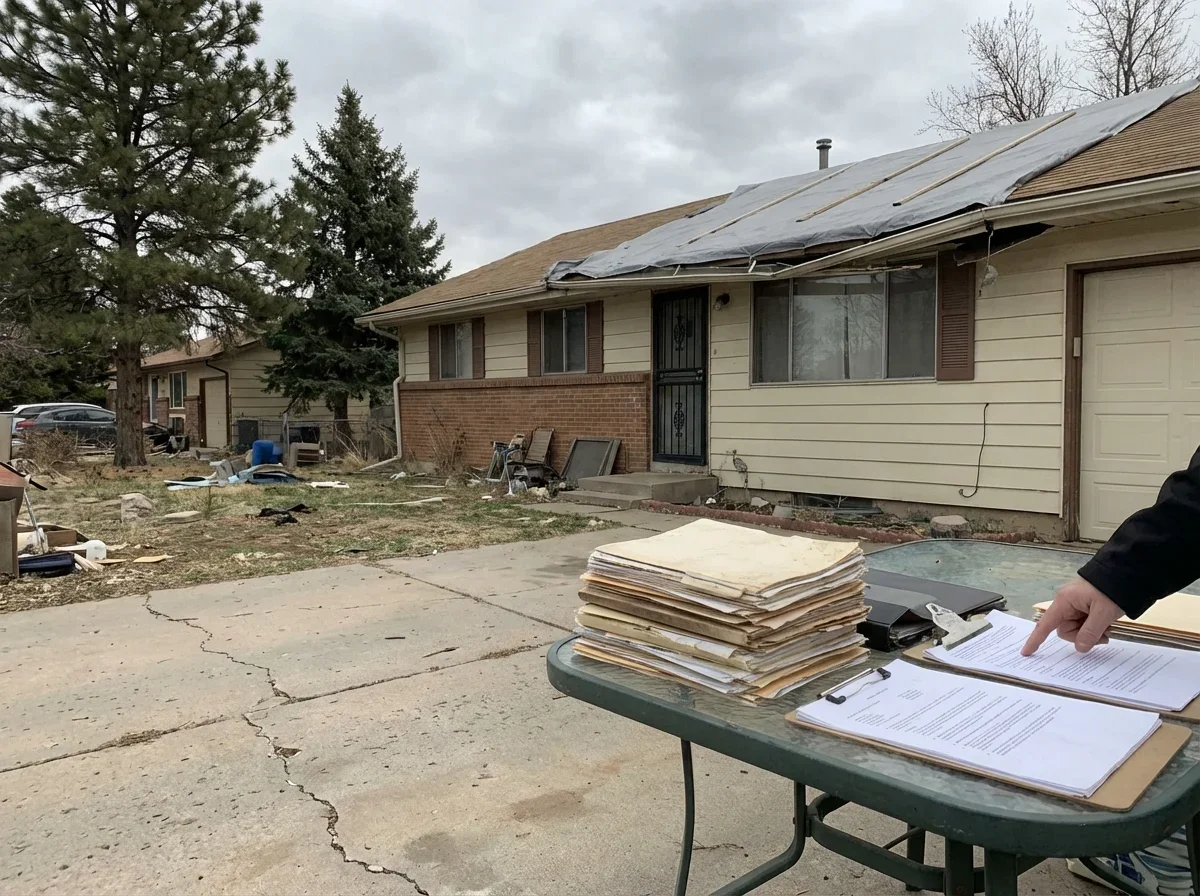
After hail storms, most Denver and Colorado Springs homeowners file claims within 48 hours — but 60% accept initial settlements that miss critical damage and leave thousands unclaimed.[1]
You need professional claim assistance if:
- Your roof sustained hail damage from stones 1"+ in diameter (the threshold where insurance companies typically approve full replacement in Colorado's Front Range)
- Your initial claim was denied or the adjuster's estimate is $5,000+ lower than contractor quotes
- You have an older roof (12+ years) and the adjuster is applying depreciation schedules that reduce your payout to 60-70% of replacement cost
- The adjuster refused to inspect your attic, dismissed obvious granule loss, or pressured you to accept a settlement same-day
- You're facing code-compliance upgrades — Denver's 2018 building code requires ice and water shield at all eaves and valleys, which older policies don't automatically cover as "matching"
Timing determines recovery. State Farm and Farmers (41% of Denver County homeowner policies) limit depreciation recovery to 180 days from the loss date — miss that window and you forfeit 25-40% of your claim value permanently.
Colorado experiences 7-12 significant hail events annually along the Front Range corridor.
The difference between a $15,000 settlement and a $28,000 settlement isn't the damage — it's the documentation and negotiation expertise.
What Does Roof Insurance Claim Assistance Cost in Colorado?
Most roofing contractors in Aurora, Thornton, and across Colorado provide claim assistance at no separate charge — it's included when you hire them for the repair work.
This is fundamentally different from hiring a public adjuster.
Contractor-Provided Assistance (Typically Free)
| Service Component | Included in Repair Contract |
|---|---|
| Initial damage inspection | Free (part of estimate) |
| Documentation and photo report | No charge |
| Adjuster meeting attendance | Included |
| Estimate negotiation | No additional fee |
| Supplement filing | Included in scope |
| Depreciation recovery support | No charge |
Why it's free: Contractors recover costs through the insurance settlement — their incentive is maximizing your approved claim amount because that determines the scope of work they can perform.
Public Adjuster Fees vs. Contractor Support
Public adjusters charge 10-15% of your total settlement[2] — on a $25,000 claim, that's $2,500-$3,750 out of your pocket.
They're warranted in specific scenarios:
- Your claim was denied outright and you're appealing
- You're disputing a settlement after 90+ days with no resolution
- Your policy has complex coverage questions (commercial property, multi-unit buildings)
For standard hail and wind damage claims in Lakewood, Arvada, or Greeley, experienced roofing contractors achieve equivalent settlement increases without the percentage fee.
Hidden Costs of Not Getting Professional Help
DIY claim filing saves nothing. It costs you:
- $5,000-$12,000 in unclaimed depreciation — most homeowners don't know to file depreciation recovery or miss carrier-specific deadlines (180 days for State Farm/Farmers, 365 days for USAA/Allstate)
- 30-40% lower initial settlements — adjusters know homeowners don't speak Xactimate language or understand code-compliance leverage points
- Voided warranties — DIY repairs or unlicensed contractors create manufacturer warranty exclusions
- Claim denial risk — incomplete documentation gives carriers grounds to deny or severely reduce payouts
Denver's median roof age is 18 years — policies depreciate 5-7% annually after year 10, meaning a 15-year-old roof receives only 65-75% RCV on initial payout.
Professional depreciation recovery is the difference between $2,000 out-of-pocket and $10,000+.
Get Colorado-specific pricing based on material, region, and roof size.
The Insurance Claim Process for Roof Damage
Professional claim assistance guides you through four distinct phases where most homeowners lose money without realizing it.
Initial Damage Assessment and Documentation
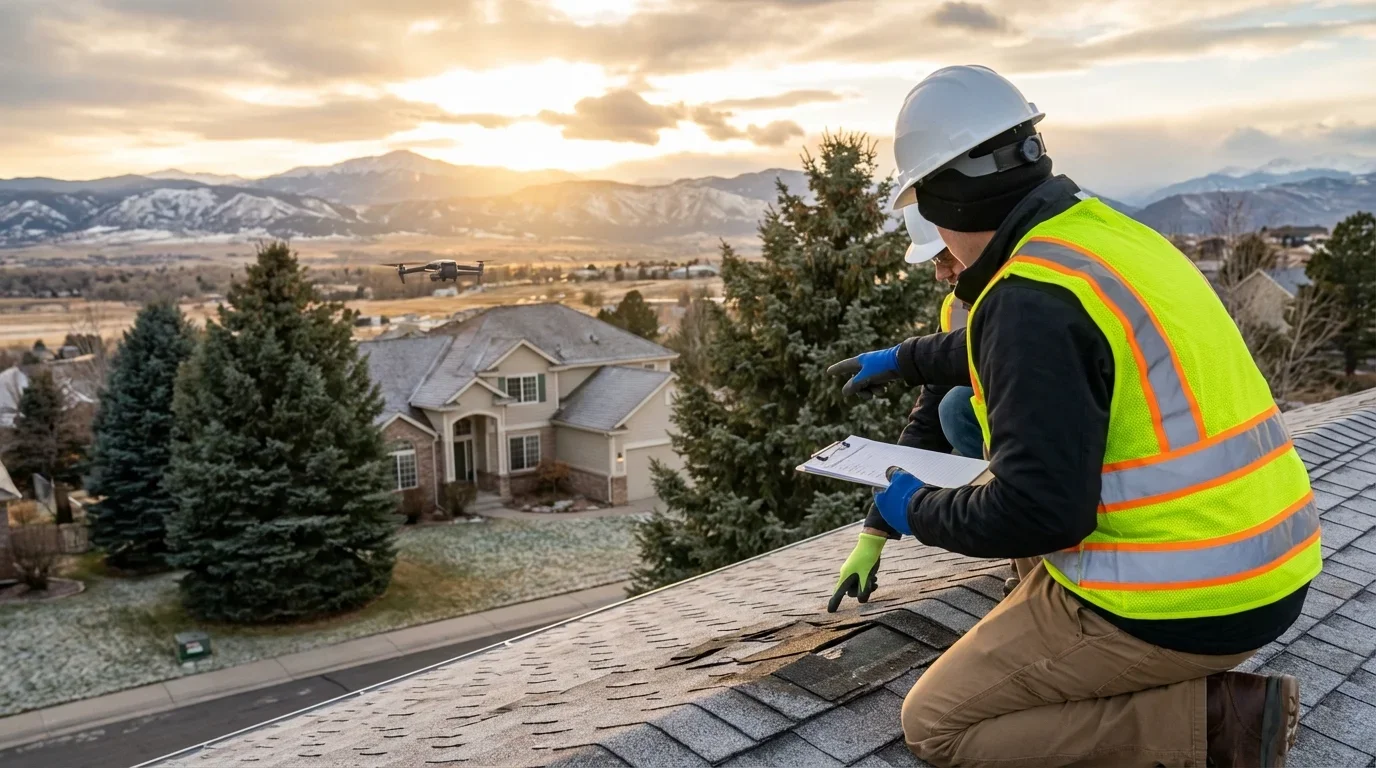
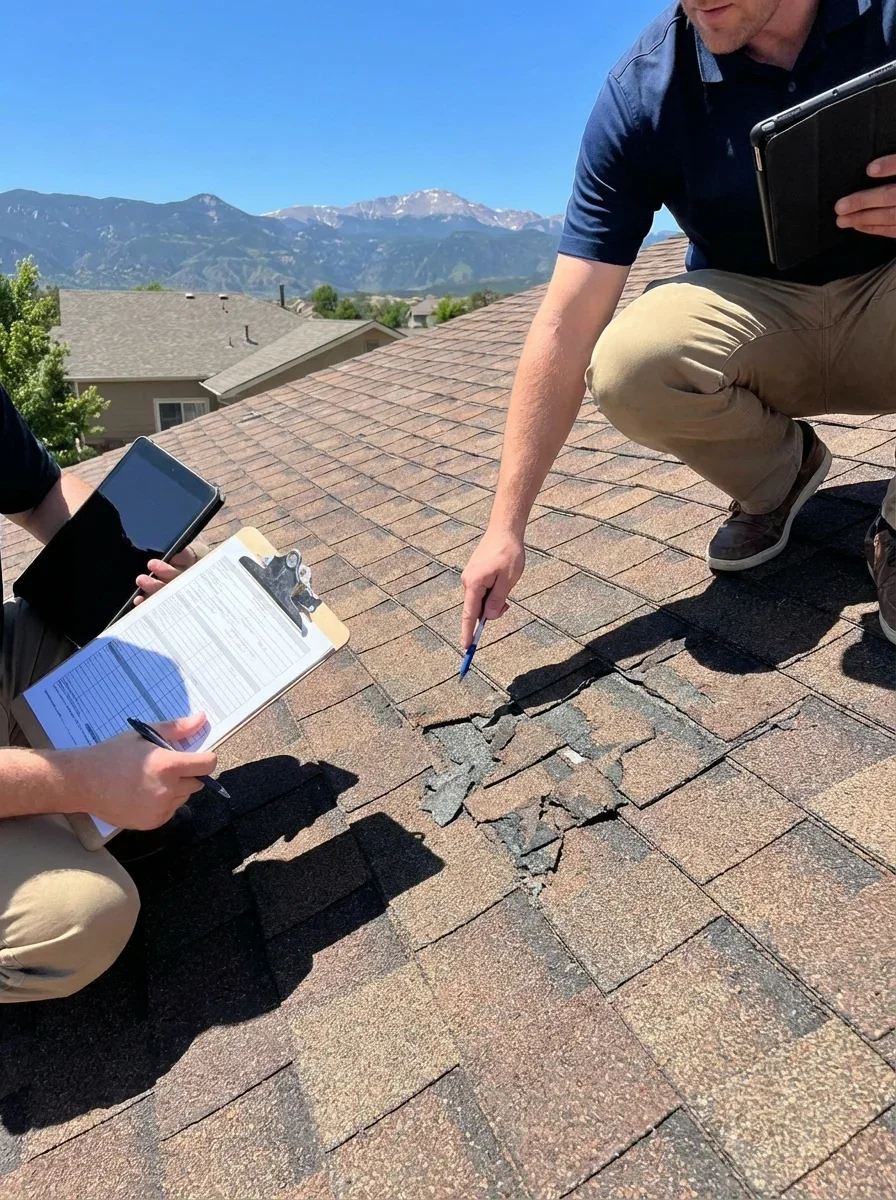
A qualified contractor (ideally Haag Certified Inspector credentialed) conducts a comprehensive roof inspection within 24-48 hours of your request:
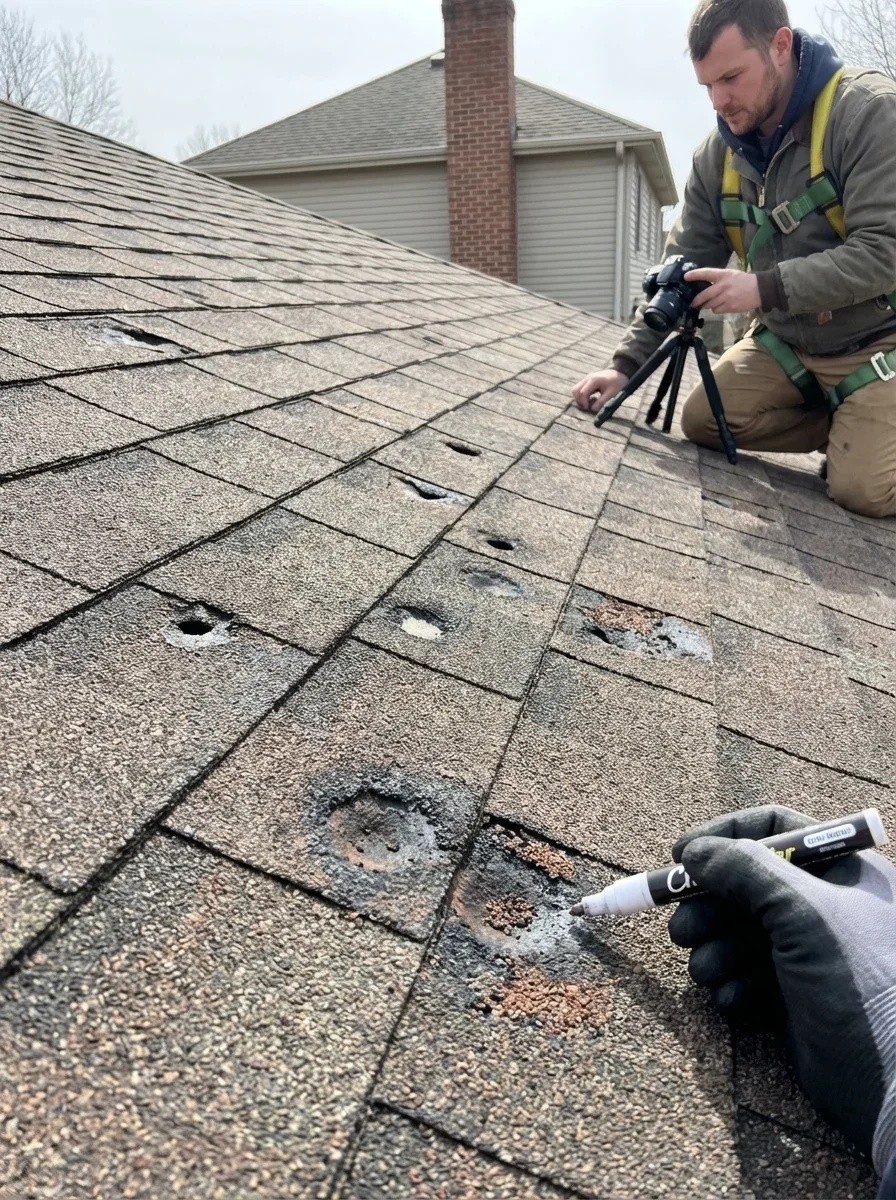
- Test square analysis — systematic inspection of a 10x10 section to quantify hail impacts per square foot
- Multi-angle photo documentation — date-stamped images from 8+ angles showing damage patterns, granule loss in gutters, and seal integrity failure
- Xactimate-compatible measurements — roof dimensions matching the same software your insurance adjuster uses (Xactimate Zone 2 pricing for Denver metro shows $385-$425 per square currently)
- Pre-existing condition notes — documented evidence separating storm damage from age-related wear, critical for dispute resolution
Filing the Claim and Adjuster Inspection
Your contractor provides a detailed written estimate that you submit with your claim. Colorado law requires insurers to acknowledge claims within 10 working days and investigate within 30 days[1] — but "complete documentation" is the lever that starts the clock.
When the adjuster arrives (typically 7-14 days after filing), your contractor should be present for the inspection.
This prevents:
- Missed interior damage (attic moisture stains, underlayment failure)
- Understated scope (adjusters initially miss ~40% of damage that supplements later recover)
- Incorrect material classifications that reduce settlement amounts
Estimate Review and Negotiation
You'll receive the adjuster's estimate within 3-5 days.
This is where most homeowners lose money by accepting the first number. Professional assistance identifies:
| Common Adjuster Underestimates | Typical Recovery Amount |
|---|---|
| Insufficient squares measured | $2,500 - $5,000 |
| Missing valley/ridge components | $800 - $1,800 |
| Incorrect material grade listed | $1,200 - $3,200 |
| Omitted code-compliance upgrades | $1,500 - $4,000 |
Your contractor submits a line-item comparison report showing discrepancies. In Colorado Springs, Fort Collins, and Boulder, this negotiation phase typically adds $3,000-$8,000 to initial settlements.
Supplemental Claims and Depreciation Recovery
The claim isn't over when work begins — two critical recovery phases follow:
Supplement filing — when tear-off reveals hidden damage (rotted decking, failed underlayment), your contractor documents and submits supplement claims. Initial estimates miss this 40-60% of the time.
Depreciation recovery — after work completion, you file for the "recoverable depreciation" withheld from your initial payment (typically 20-40% of total claim value). Your contractor provides proof of completion, permits, and final invoicing. For a $25,000 claim, this recovers $5,000-$10,000.
Timeline expectations: 30-60 days for straightforward approvals, 90+ days when supplements and negotiations extend the process.[1]
How to Choose an Insurance Claim Assistance Provider
Most Colorado homeowners don't realize that the contractor you choose directly determines how much of your claim you recover.
Selection criteria that separate effective assistance from hollow promises:
Questions to Ask Before Signing
- "Are you Haag Certified (HCI-R) for storm damage inspection?" — This is the industry-recognized credential for hail/wind documentation. Haag reports use standardized test square methodology that adjusters cannot dismiss as subjective opinion.
- "Do you use Xactimate estimating software?" — 90%+ of Colorado insurance adjusters use Xactimate. Contractors using different systems create automatic negotiation friction.
- "What's your supplement approval rate?" — Experienced contractors recover supplements on 60-70% of claims (revealing hidden damage). Rates below 40% indicate insufficient documentation practices.
- "Can you provide your Denver contractor's license number?" — Verify at denvergov.org. Unlicensed contractors create claim denial risk under policy compliance clauses.
- "Who attends the adjuster inspection with me?" — The answer should be "a company representative who's attended 50+ adjuster meetings" — not "we'll send our estimate and you meet them alone."
- "What's your timeline for depreciation recovery filing?" — Should be "within 7 days of final inspection and permit sign-off." Delays cost you thousands if you miss carrier deadlines.
Credentials That Matter
Beyond licensing, verify:
- Colorado Roofing Association (CRA) membership — requires proof of liability insurance ($500K+), workers' comp, and two years in business. Check the CRA directory at coloradoroofing.org.
- Xactimate certification — verifiable through Xactware's public directory
- Manufacturer certifications — GAF Master Elite, CertainTeed SELECT ShingleMaster, or Owens Corning Platinum status indicates warranty expertise that strengthens material upgrade negotiations
Red Flags to Avoid
- Demands you sign a contractor agreement before the adjuster inspection — legitimate contractors provide estimates first
- Offers to "eat your deductible" or waive it entirely — this is insurance fraud in Colorado and voids your claim
- Pressures you to file a claim when you're uncertain damage exists — fraudulent claim filing carries criminal penalties
- Cannot provide current liability insurance certificate — Senate Bill 38 requires contractors to list carrier name, policy number, and contact info in contracts over $1,000
- Uses scare tactics about "storm chasers" while exhibiting storm-chaser behavior — legitimate local contractors have verifiable business addresses and years of BBB history
The best claim assistance comes from contractors with 5+ years of Colorado-specific experience, who understand carrier-specific negotiation patterns (State Farm's resistance to ridge vent upgrades, Farmers' systematic underlayment denials, Allstate's preference for repair-in-place vs. replacement).
Ask for references from recent claims in Pueblo, Longmont, or Grand Junction where you can verify settlement outcomes.
Start by comparing contractors who offer free hail damage assessments — initial inspections reveal whether you have a viable claim before you commit to any provider.
Frequently Asked Questions
- Colorado Division of Insurance. "Insurance Claims Questions and Answers." https://doi.colorado.gov/insurance/claims-questions-and-answers. Accessed April 08, 2026.
- Colorado Division of Insurance. "How to File an Insurance Claim." https://doi.colorado.gov/insurance/how-file-insurance-claim. Accessed April 08, 2026.
- Colorado Division of Insurance. "Property Insurance Guidelines." https://doi.colorado.gov/insurance/property-insurance-guidelines. Accessed April 08, 2026.
Related Articles
Need Help With Your Project?
Join 500+ homeowners we've helped