
Ponding Water and Drainage Failures
Flat roofs aren't actually flat — they need a minimum slope (typically 1:12 or 8% for residential low-slope systems in Denver) to move water toward drains and scuppers.[4] When that slope is inadequate or drainage paths become blocked, water pools in low spots. The industry benchmark is 72 hours: standing water that remains longer than three days after rainfall signals a drainage failure that will shorten your roof's lifespan.
Colorado's climate makes ponding particularly destructive. Summer afternoons in Denver hit 90°F, baking ponded water into the membrane. UV radiation at altitude — 50% more intense than at sea level — accelerates membrane degradation wherever water magnifies the sun's effect. Then overnight temperatures drop into the 40s, cycling the same wet area through contraction and expansion.
Over months, this creates soft spots where the membrane delaminates from insulation underneath.
How Ponding Leads to Hidden Insulation Damage
The real cost isn't visible from the roof surface. Ponding water slowly saturates the insulation beneath the membrane through microscopic cracks and seam imperfections. Homeowners discover this during core sampling — a waterlogged 4-inch insulation section that's been wet for years while the membrane looked intact.
Once insulation is compromised, it compresses under foot traffic and creates depressions that trap more water, accelerating the cycle.
Longmont's building code addresses this directly: over 100 square feet of cumulative membrane damage requires full roof replacement for commercial buildings under amended IBC section 1511.3.1.[2] What started as a single ponding area metastasizes into widespread failure that can't be spot-repaired.
Common Drainage Bottlenecks
Flat roofs fail at predictable points. Internal drains clog with pine needles and asphalt granules washed off adjacent sloped sections. Scuppers freeze shut during winter, backing water onto the roof during spring snowmelt. Poor initial design concentrates runoff at downspout locations instead of distributing it across multiple drain points.
A flaw that causes blisters and membrane holes within 5-6 years on otherwise durable EPDM systems.
You can spot drainage problems before they cause leaks. Walk your roof after a rainstorm and mark any area where water remains pooled 24 hours later. Check drain strainers monthly during cottonwood season (May-June along the Front Range) when seed fluff clogs openings. Install additional scuppers or internal drains if your roof consistently shows ponding.
Don't wait for the membrane to fail.
Quick Drainage Check Timeline:
- 24 hours post-rain: Walk roof and mark standing water locations
- 72 hours post-rain: Re-check marked areas — persistent water signals failure
- Monthly May-June: Clear drain strainers during cottonwood season
- After every storm: Verify scuppers haven't frozen or clogged
- Annually: Consider adding drains if ponding persists despite maintenance
Freeze-Thaw Cycling and Thermal Shock
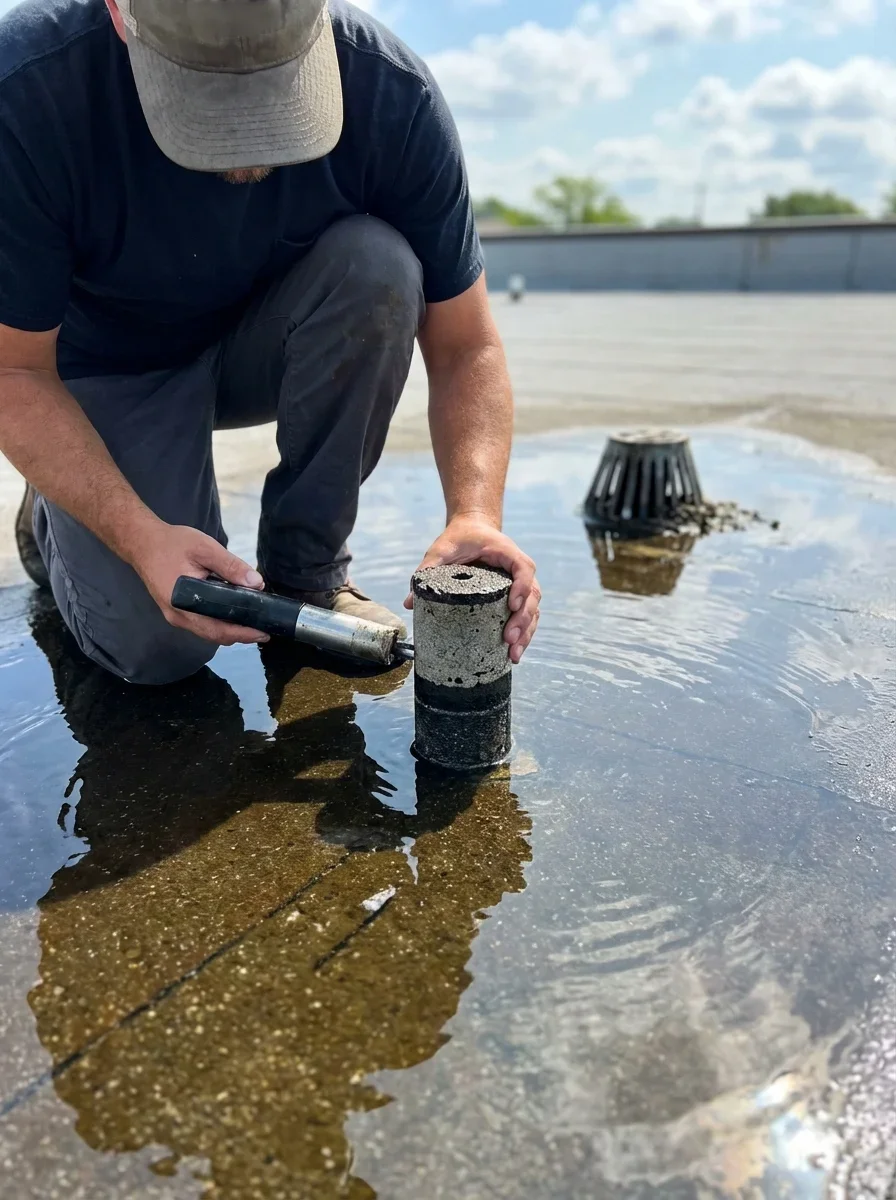
Colorado's daily temperature swings create a cycle that tears roofing materials apart from the inside. A February day in Denver starts at 15°F, climbs to 55°F by 2 PM during a Chinook wind event, then drops back to 20°F overnight. Water trapped in membrane seams, flashing joints, or beneath the top layer expands by 9% when it freezes.
The ice crystals force cracks wider. When the ice melts, more water infiltrates. The next freeze cycle splits the crack further.
This happens dozens of times each winter across hundreds of locations on a single roof. Seams between EPDM sheets develop pinhole leaks. Modified bitumen laps separate. TPO welds crack at the edges where thermal contraction creates the most stress. The damage accumulates invisibly until spring when the first heavy rain finds every compromised joint.
Where Freeze-Thaw Damage Concentrates
Check the north-facing roof sections first. These areas stay frozen longer, cycling through freeze-thaw transitions more frequently than south-facing sections that warm quickly in morning sun.
Parapet walls and roof edges experience the most extreme temperature differentials. The exposed vertical surface radiates heat faster than the horizontal deck, creating stress at the transition point where flashing meets the membrane.
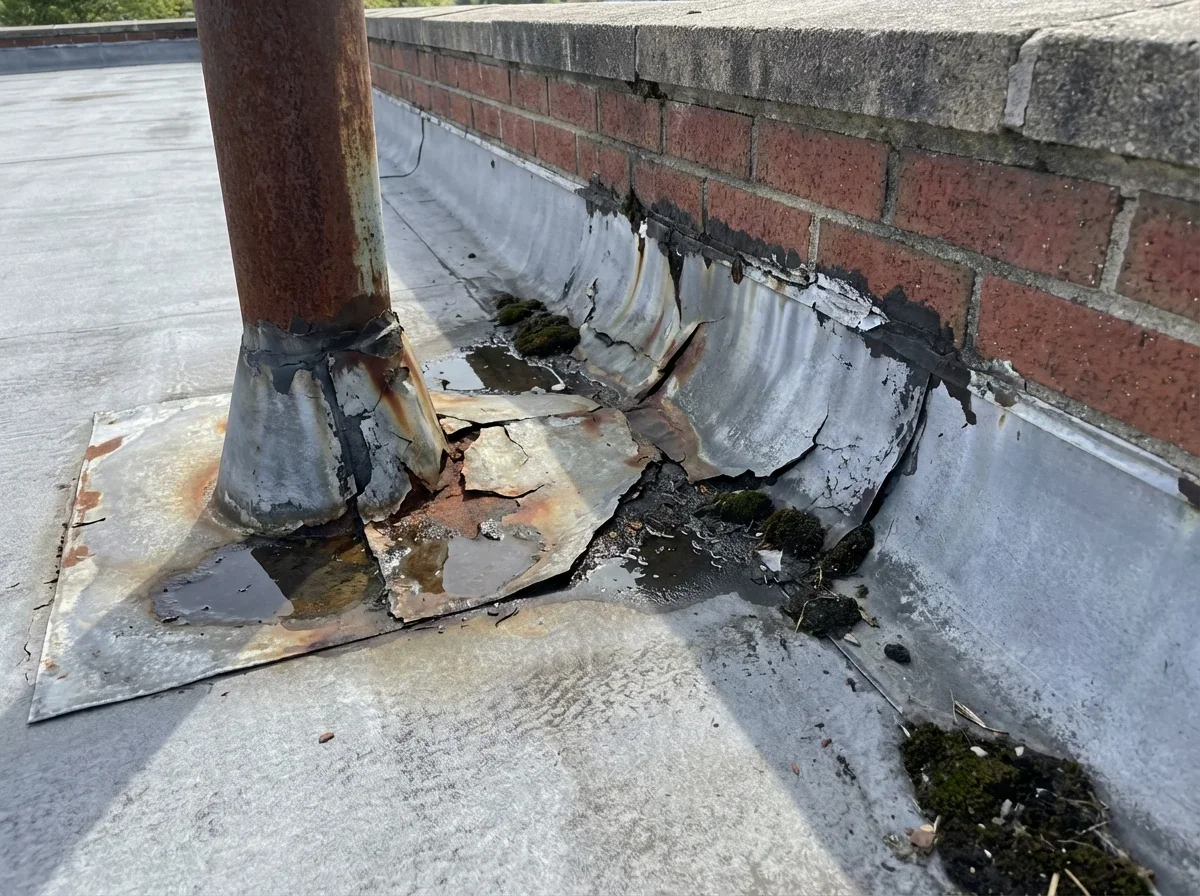
Penetrations are the second critical zone. Every HVAC curb, vent pipe, and skylight creates a thermal bridge where interior heat escapes. Snow melts around these spots during the day, then refreezes at night. The constant wet-dry-freeze cycle breaks down sealants and opens gaps in flashing boots that look perfectly intact during a summer inspection.
UV Degradation at Altitude
Denver sits at 5,280 feet. Boulder at 5,430. Breckenridge at 9,600.
The atmosphere is thinner at altitude, filtering less UV radiation. Your flat roof absorbs roughly 50% more UV exposure than an identical roof in Houston or Atlanta. This accelerates material breakdown by 25-30% compared to manufacturer lifespan estimates based on sea-level testing.
EPDM membranes become brittle and crack along seams. TPO loses plasticizers, turning chalky and stiff. Modified bitumen granules erode, exposing the underlying felt to direct UV that breaks down the asphalt binder. What's sold as a 20-year roof often needs replacement in 14-16 years under Colorado's UV load, even with perfect maintenance.
Recognizing UV Damage Before Leaks Start
Surface crazing is the early warning sign. Run your hand across an EPDM membrane in spring after winter moisture has evaporated. If the surface feels rough or shows a network of fine surface cracks (like dried mud), UV degradation has begun.
TPO membranes show chalking — a white powdery residue that comes off on your gloves. Modified bitumen loses granule coverage, revealing black felt underneath.
You can extend membrane life with UV-reflective coatings. Silicone or acrylic elastomeric coatings create a sacrificial layer that absorbs UV before it reaches the membrane. These coatings need reapplication every 5-7 years, but they're far cheaper than membrane replacement. They also reduce summer cooling loads by reflecting solar heat.
A meaningful benefit when your roof deck reaches 160°F on a July afternoon.
Pro Tip: Test for UV degradation during spring inspections by running a gloved hand across your membrane. EPDM should feel smooth and flexible — roughness or surface cracks signal UV breakdown has begun. TPO that leaves white residue on your gloves needs coating within the year to prevent accelerated failure.
Membrane Blistering and Delamination
Blisters form when moisture trapped between membrane layers vaporizes on hot days. The steam creates pockets that lift the membrane away from the adhesive or insulation below. Small blisters (under 2 inches) are cosmetic.
Large blisters indicate widespread adhesive failure or wet insulation that needs immediate attention.
Colorado's dry climate paradoxically makes this worse. Contractors sometimes install membranes early in the morning when dew has condensed on the roof deck or insulation. The membrane seals in that moisture. By afternoon when the deck heats up, the trapped water has nowhere to go except up, pushing the membrane into a blister. High-altitude sun makes deck temperatures extreme — dark EPDM can hit 180°F, well above water's boiling point.
Why Blisters Spread in Freeze-Thaw Environments
A blister compromises membrane integrity. Water infiltrates around the blister's edges during rain. That water freezes in winter, expanding the delaminated area. Next summer, a larger area blisters.
The cycle compounds until a fist-sized blister becomes a 3-foot section of failed membrane.
Cut open a blister and you'll often find wet insulation underneath — evidence that the problem started long before the blister appeared. This is why core sampling matters during roof inspections. A contractor can take 3-4 core samples across the roof to check insulation moisture content without causing significant damage.
If cores show saturation, you're looking at full replacement. If insulation is dry, blisters can be cut out and patched.
Flashing Failures at Penetrations and Parapets
Flat roofs have more penetrations per square foot than sloped roofs: HVAC units, vent pipes, skylights, roof hatches. Every penetration requires flashing to seal the transition from horizontal membrane to vertical surface. These transitions fail more frequently than the field membrane because they experience differential movement.
Colorado's expansive clay soil (bentonite) along the Front Range swells when wet and shrinks during drought. This causes foundation movement that shifts the entire building structure by fractions of an inch. Enough to break flashing seals at parapets and curbs.
A parapet wall that moves 1/4 inch outward during spring soil expansion pulls the flashing counter-flashing joint apart. Water infiltrates the gap and runs down the interior wall cavity.
Parapet Wall Vulnerabilities
Parapets are the most failure-prone flashing detail. The membrane has to transition from horizontal to vertical, then cap over the top of the wall and down the exterior side. That's three 90-degree turns where the material experiences maximum stress during thermal expansion.
Add freeze-thaw cycles and UV exposure on the vertical surfaces, and you have a joint that fails in 8-10 years even when the field membrane lasts 15.
Denver's residential roofing guidelines require modified rolled roofing or EPDM for low-slope applications below 1:12 pitch.[4] But the guidelines don't specify parapet detailing — that's left to contractor workmanship. Poor installations skip the cant strip (a triangular filler that creates a gradual angle instead of a sharp 90-degree turn) or fail to mechanically fasten the counter-flashing.
The result is flashing that pulls away from the wall during the first winter.
HVAC Curb and Pipe Penetration Issues
Rooftop HVAC units require regular service. Technicians walk across the roof, lean equipment against curbs, and sometimes set tools directly on the membrane. Each service visit risks puncturing the membrane or compressing insulation around the curb.
Over years, the area surrounding HVAC units develops a bowl-shaped depression from repeated traffic. A perfect spot for water to pond.
Pipe flashing fails when the rubber boot deteriorates under UV. These boots are often the lowest-quality component on the roof because they're inexpensive and easy to replace — except nobody remembers to replace them until they leak. A $15 vent boot that fails lets water run down the pipe into your wall cavity.
Check every pipe penetration annually and replace boots that show cracking or have lost flexibility.
| Penetration Type | Typical Lifespan | Primary Failure Mode | Replacement Cost | Inspection Frequency |
|---|---|---|---|---|
| Pipe Boots | 5-8 years | UV degradation, cracking | $15-50 per boot | Annually |
| HVAC Curbs | 10-15 years | Traffic damage, ponding | $400-800 per curb | After each service visit |
| Skylights | 12-18 years | Seal failure, frame movement | $600-1,500 each | Bi-annually |
| Parapet Flashing | 8-12 years | Thermal stress, soil movement | $25-40 per linear foot | Spring and fall |
Storm Damage: Hail, Wind, and Debris Impact
Colorado averages seven significant hail events per year along the Front Range corridor — more than anywhere else in the continental US. Hail that merely dents asphalt shingles can punch clean through a flat roof membrane. A 1.5-inch hailstone traveling at 60 mph carries enough energy to crack EPDM, shred TPO seams, and crater modified bitumen.
The damage isn't always obvious. Small punctures seal themselves temporarily as the membrane relaxes after impact. But the structural integrity is compromised.
Water infiltrates slowly through the micro-fractures. By the time the leak shows up inside, you're past the insurance claim window — most policies require notification within one year of the storm event.
Wind Uplift and Edge Metal Failures
Flat roofs experience higher wind uplift pressures than sloped roofs because wind can't flow over and off the surface — it hits the parapet or roof edge and creates a lifting force. Colorado's Chinook winds regularly hit 60-70 mph along the Front Range. These events can peel back membrane sections that weren't properly adhered or mechanically fastened.
Edge metal failures start small. A single screw backs out. Wind gets under the metal and lifts it slightly. The next wind event peels back more.
Eventually, the membrane loses its mechanical attachment and the edge section flaps loose.
This type of damage accelerates quickly — a small edge failure in November can become a 10-foot section of loose membrane by March if winter storms keep working the edge. Inspect roof perimeters after every significant wind event and re-secure loose metal immediately.
Debris Accumulation and Organic Growth
Cottonwood trees drop seed fluff in late spring. Ponderosa pines along the foothills shed needles year-round. This organic debris collects in roof valleys, around drain strainers, and against parapet walls. When it gets wet, it holds moisture against the membrane.
When it dries, it provides a growth medium for algae and moss.
Algae itself doesn't damage modern membranes, but it signals chronic moisture — which does. Moss roots can work into seams and gradually pry them apart. More critically, the debris layer clogs drainage paths and creates the ponding conditions that lead to membrane failure.
A twice-yearly cleaning (spring and fall) removes accumulation before it causes problems. This is especially important for roofs under tree canopy where debris load is constant.
Improper Installation and Material Selection
Many flat roof failures in Colorado trace back to installation errors that aren't discovered until years later. Contractors who primarily work on sloped asphalt roofs sometimes lack the specialized knowledge that flat roofing requires. They skip tapered insulation that creates positive drainage. They use the wrong adhesive for cold-weather installation.
They don't account for Colorado's UV exposure when selecting membrane thickness.
Adams County's residential roofing requirements specify that the maximum number of layers on a flat roof is one.[1] This is stricter than code in many states. It exists because flat roofs can't support the weight of multiple membrane layers plus accumulated water from poor drainage. Yet contractors occasionally attempt overlays to save costs, creating a code violation that won't pass inspection and voids manufacturer warranties.
Membrane Selection for Colorado's Climate
Not all membranes perform equally at altitude and in freeze-thaw conditions. EPDM (ethylene propylene diene monomer) rubber remains flexible at low temperatures and handles UV well, but seams are vulnerable because they rely on adhesive bonds that fail under thermal cycling.
TPO (thermoplastic polyolefin) offers heat-welded seams that are stronger than EPDM's adhesive joints, but early TPO formulations became brittle under UV. Newer formulations perform better, but product quality varies by manufacturer.
Modified bitumen with a granulated cap sheet provides good UV protection and proven performance in Colorado's climate. The granules shield the asphalt from UV the same way they protect asphalt shingles. But modified bitumen requires torch-down application or hot-mopping, which carries fire risk and isn't suitable for all building types.
Your contractor selection should consider material track record in Colorado's specific conditions, not just national performance data.
Cold-Weather Installation Failures
Membrane adhesives and sealants require minimum temperatures to cure properly — typically 40-50°F depending on the product. Colorado's extended shoulder seasons tempt contractors to push installation windows into late fall or early spring when daytime temps reach 60°F but mornings start below freezing.
Adhesive applied at 55°F may never achieve full bond strength, leading to seam failures within the first year.
This creates a quality control problem you can't easily verify. The roof looks fine at final inspection. Six months later, seams start separating. By then, the contractor may have moved on to another project or left the state (a common pattern with storm-chaser contractors who flood Colorado after hail events).
This is why verifying contractor local presence and warranty backing matters. Check the Colorado Division of Industrial Affairs for complaint history, and confirm the contractor maintains a physical office in-state rather than operating from a P.O. box.
Inadequate Roof Slope and Tapered Insulation
Many flat roof "failures" are actually design flaws built in from day one. The roof was installed correctly per plan, but the plan specified inadequate slope for Colorado's rainfall intensity and snowmelt runoff.
A roof with 1/8-inch per foot slope might drain acceptably in Arizona. In Colorado, where spring snowmelt dumps the equivalent of 2-3 inches of rainfall across the roof in a few hours, that same slope creates ponding areas that never dry.
Tapered insulation systems solve this by creating slope where the structural deck is flat. Rigid foam panels vary in thickness from 1 inch at the high point to 4+ inches at the drain, creating the necessary gradient for positive drainage. Retrofitting tapered insulation during a roof replacement adds cost — typically $2-3 per square foot for materials and labor.
But it eliminates ponding problems that would otherwise require re-roofing again in 5-7 years.
Cricket and Saddle Requirements
Large rooftop equipment creates dams that block water flow. A 6-foot HVAC unit positioned mid-roof acts like a barrier, forcing water to flow around it. Without a cricket (a small peaked structure that diverts water around the obstruction), water ponds against the upslope side of the unit.
Denver's roofing guidelines don't explicitly require crickets for all penetrations, but good practice and manufacturer installation instructions do.
The same principle applies to chimneys, elevator shafts, and any protrusion wider than 30 inches. Water needs a path around obstacles. When that path doesn't exist, it finds the weakness in the flashing and infiltrates.
Adding crickets during initial installation costs $200-400 per unit. Adding them during a remediation visit after leaks have damaged interior drywall and insulation costs far more once you factor in the interior repairs.
Code Compliance and Inspection Requirements
Colorado's lack of state-level roofing licensing means enforcement varies dramatically by municipality. Denver requires permits for virtually all roofing work and maintains specific residential roofing guidelines.[4] The city mandates removal of existing roofs to the deck when two or more layers exist, with no continuous opening between boards greater than 1/2 inch.[3]
But in unincorporated areas or small mountain towns, enforcement may be minimal.
This creates risk for homeowners who assume their contractor pulled proper permits. Unpermitted work can void manufacturer warranties and complicate insurance claims. If you file a hail damage claim and the adjuster discovers your roof was replaced without permits five years ago, the insurer may deny coverage based on non-compliant installation.
Even if the installation itself was done correctly.
Final Inspection Requirements
Parker requires final inspections for all roof permit applications, with daily limits on residential inspections.[5] This prevents contractors from scheduling back-to-back inspections and forces them to complete each job fully before moving to the next. The inspection verifies code compliance, proper fastener spacing, flashing details, and that old roofing materials were removed per code.
What gets checked during inspection? Membrane attachment method (adhesive, mechanical fasteners, or ballast), flashing terminations, edge metal securement, and drainage slope verification. The inspector may request core samples if they suspect wet insulation.
This is why you want inspections — they catch installation errors before they become your problem.
Roof inspection costs for compliance verification run $200-400, but that investment prevents issues that cost thousands to remediate.
Maintenance Gaps and Inspection Frequency
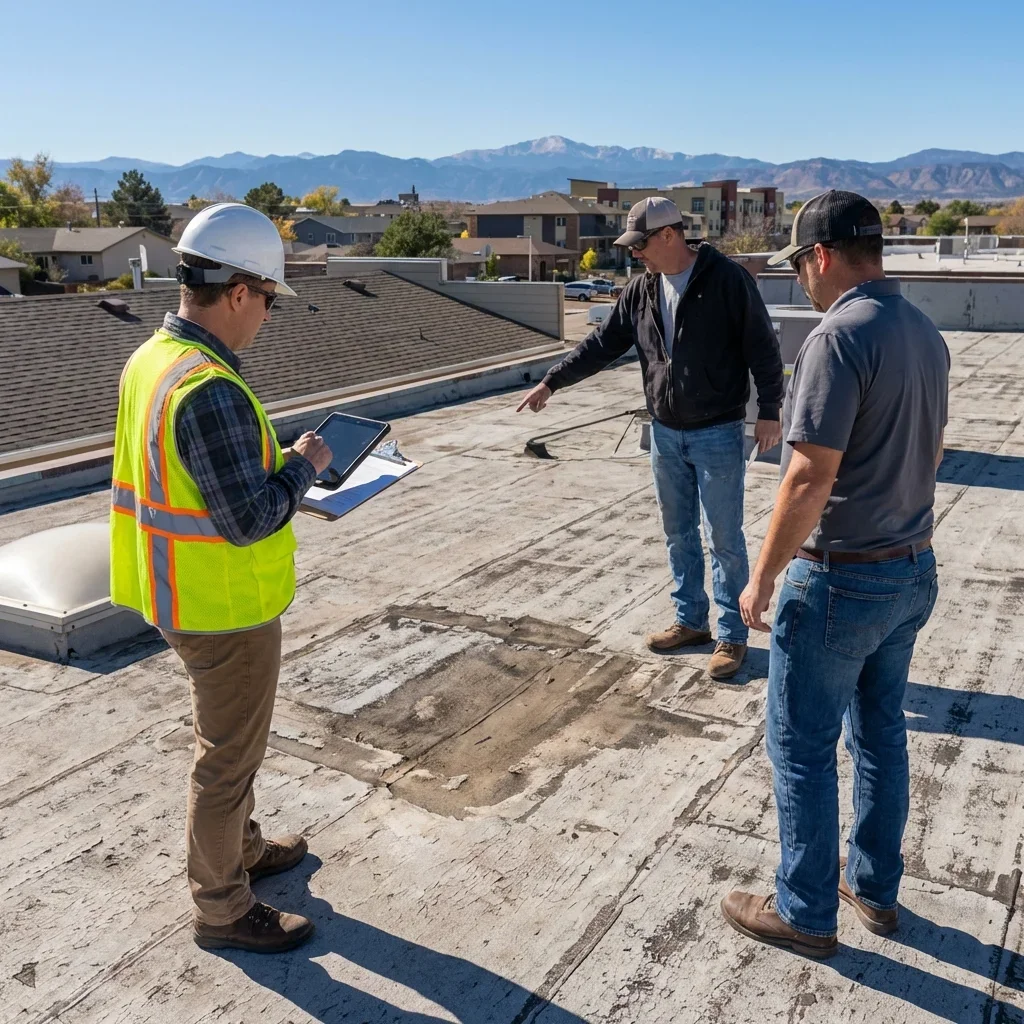
Flat roofs hide damage until it's catastrophic. A sloped asphalt roof shows granule loss, curling shingles, and obvious wear. A flat roof looks fine until the day a technician's foot punches through a weak spot.
This is why twice-yearly inspections are essential, not optional maintenance.
Schedule inspections in spring (after snowmelt and before summer UV exposure peaks) and fall (after monsoon season and before winter freeze-thaw begins). A professional inspection runs $200-350 for residential roofs and includes drain cleaning, seam checks, flashing examination, and moisture meter readings to detect hidden saturation.
Some contractors offer annual maintenance programs that include inspections plus minor repairs for a flat annual fee — typically $400-600 for residential flat roofs.
What Homeowners Miss During DIY Inspections
You can't see membrane delamination from the surface. You can't detect early-stage UV degradation without a close-up examination. You won't spot the 1/8-inch gap developing at a parapet counter-flashing where the caulk has failed.
These are the failures that inspectors with moisture meters, infrared cameras, and 20 years of experience catch during routine visits.
The cost differential is stark. A $300 inspection that catches a failing pipe boot before it leaks costs $300. The same boot discovered after it's leaked for six months costs $300 for the boot replacement plus $2,000-4,000 for interior drywall and insulation remediation.
Catch problems early or pay exponentially more to fix them after water damage spreads.
When Repair Crosses the Threshold to Replacement
Colorado's building codes create bright-line rules for when repairs are no longer adequate. Longmont's amendment to IBC section 1511.3.1 requires full replacement when cumulative membrane damage exceeds 100 square feet for commercial buildings.[2] Denver's guidelines prohibit overlays when two layers already exist.[3]
Adams County limits flat roofs to a single layer.[1]
These aren't arbitrary limits. They reflect structural realities. Multiple membrane layers add weight that flat roof structures weren't designed to carry, especially when those layers trap water.
Widespread damage signals systemic failure — patching individual spots doesn't address the underlying cause (inadequate slope, failed insulation, deteriorated substrate).
Core Sampling as the Deciding Factor
Before committing to a $15,000-25,000 replacement, request core sampling. A contractor drills 3-4 cylindrical samples through the membrane and insulation to the deck. These cores reveal moisture content, insulation compression, deck condition, and whether previous repairs were done properly.
Wet insulation means replacement. Dry insulation with isolated membrane damage means targeted repairs may suffice.
Some homeowners resist core sampling because it "damages" the roof. But a 3-inch hole that's immediately patched causes far less damage than replacing an entire roof that didn't need replacement — or conversely, patching a roof that has hidden structural issues requiring replacement anyway.
The $400-600 cost of sampling and analysis pays for itself by ensuring you make the right repair-vs-replace decision.
If replacement is necessary, prioritize upgrades that address Colorado-specific challenges: tapered insulation for positive drainage, UV-resistant membrane formulations rated for high-altitude exposure, mechanically fastened systems that resist wind uplift, and Class A fire-rated materials if you're in a wildfire interface zone. Your flat roof installation contractor should specify these elements based on your location along the Front Range or in mountain communities where snow load and fire risk become primary concerns.
Post-Storm Response and Emergency Protocols
When hail shreds your membrane or wind peels back an edge section, response time determines total damage. A small puncture that's tarped within hours causes minimal interior damage.
The same puncture left exposed through a night of rain leads to ceiling collapse, insulation replacement, and potential mold remediation.
Keep a contractor relationship established before you need emergency roof repair. Contractors who know your roof can respond faster than those starting from scratch. After major hail events, reputable contractors book 6-12 months out.
If you wait until you see a leak to establish contact, you're competing with hundreds of other homeowners for limited contractor availability.
Storm chasers flood Colorado after every significant Front Range hail event. They knock doors, offer "free inspections," and pressure homeowners to sign contracts immediately. Many are legitimate contractors from other states helping with overflow demand. Others are opportunists who collect insurance checks and disappear.
Verify any contractor through local references, physical office location, and complaint history before signing. Your insurance company isn't responsible for vetting contractors — that's on you.
Document everything. Photograph damage from multiple angles immediately after the storm. Mark standing water locations. Note the date and time. This documentation supports your insurance claim and provides baseline evidence if disputes arise about what damage was storm-related versus pre-existing.
Most Colorado policies have strict notification windows — often 30-60 days from the loss event. Miss that window and you may forfeit coverage entirely, regardless of damage severity.
Frequently Asked Questions
Estimate your insurance payout and find out if filing makes sense.
- Adams County, Colorado. "Residential Roofing Requirements." https://adamscountyco.gov/wp-content/uploads/2025/08/Residential-Roofing-Requirements_2022.pdf. Accessed April 08, 2026.
- City of Longmont, Colorado. "Roofing Guidelines for Commercial and Residential Projects." https://longmontcolorado.gov/building-inspection/roofing-guidelines-for-commercial-and-residential-projects-1/. Accessed April 08, 2026.
- City and County of Denver. "Roofing Guide - Home." https://denver.prelive.opencities.com/files/assets/public/v/4/community-planning-and-development/documents/ds/inspections/roofing_guidelines_and_checklist.pdf. Accessed April 08, 2026.
- City and County of Denver. "Denver Residential Roofing Guidelines." https://www.denvergov.org/content/dam/denvergov/Portals/696/documents/Single-family_duplex/Residential_Roofing_Guidelines.pdf. Accessed April 08, 2026.
- Town of Parker, Colorado. "BUILDING DIVISION Re-Roofing Requirements." https://www.parkerco.gov/DocumentCenter/View/738/Roofing-Requirements-Handouts?bidId=. Accessed April 08, 2026.