
Material Lifespan in Colorado's High-Altitude Climate
Asphalt shingles typically last 15 to 30 years in Colorado, but that estimate assumes average conditions.
You're not getting average conditions.
Denver's elevation means 50% more UV exposure than coastal cities, which degrades the petroleum-based asphalt binder and strips protective granules 25-30% faster than manufacturer estimates suggest. Add freeze-thaw cycles—sometimes multiple times in a single day during winter—and you're looking at brittle edges and cracked tabs within 12 to 18 years on standard three-tab shingles.
Metal roofing delivers 40 to 70 years of service in the same environment, mostly because it doesn't rely on organic binders that break down under UV bombardment. Standing-seam steel or aluminum panels expand and contract with temperature swings, but they don't crack the way asphalt does. Homeowners who installed metal in the late 1980s are only now considering replacement. And often only because they want a color update, not because the roof failed.
That longevity matters more if you're planning to stay in your home long-term. If you're selling in five years, paying for a 50-year roof doesn't pencil out. But if you're raising kids in Highlands Ranch or Parker and expect to stay another 20 years, you'll replace asphalt shingles at least once during that span. Maybe twice if hail forces an early claim.
| Factor | Asphalt Shingles | Metal Roofing |
|---|---|---|
| Lifespan (Colorado climate) | 15-30 years (12-18 typical) | 40-70 years |
| UV Degradation | High (granule loss, brittleness) | Minimal (finish may fade) |
| Freeze-Thaw Tolerance | Moderate (cracking common) | Excellent (designed for expansion) |
| Best For | Budget-conscious, short-term owners | Long-term homeowners, low maintenance |
How Altitude and UV Accelerate Degradation
Colorado's thin atmosphere filters less ultraviolet radiation than lower elevations. That extra UV doesn't just fade paint. It breaks molecular bonds in asphalt shingles, causing the mat to become brittle and the granules to loosen.
You'll notice this first on south- and west-facing slopes, where granule loss shows up as dark streaks or bare patches within 10 years.
Metal roofing avoids this problem entirely. Steel and aluminum don't degrade under UV exposure. The finish might fade slightly over decades, but the structural integrity stays intact. If you're in a mountain community above 8,000 feet, where UV intensity climbs even higher and installation windows shrink to May through October, metal's resistance to photodegradation becomes a major advantage.
Upfront Cost Comparison: Installation and Materials
Asphalt shingles cost $4.50 to $8.50 per square foot installed in the Denver metro area as of 2026, depending on whether you choose standard architectural shingles or Class 4 impact-resistant options. For a typical 2,200-square-foot ranch, that's $9,900 to $18,700 total. Most installations take two to four days once materials arrive, and scheduling is relatively flexible from April through October.
Metal roofing runs $10 to $18 per square foot installed. Sometimes higher if you're choosing specialty finishes or installing in a mountain area where material transport adds 15-20% to costs. That same 2,200-square-foot home could cost $22,000 to $39,600.
The install takes longer, often four to seven days, because panels require precise measurement and attachment to prevent leaks around fasteners. You're paying two to three times more upfront, which puts metal out of reach for homeowners working within tight budgets or those planning to sell soon.
But upfront cost isn't the full picture. Factor in replacement schedules and you get a clearer view. That $12,000 asphalt roof might need replacing in 18 years after hail damage and UV wear. If you pay $14,000 for the replacement (accounting for inflation), you've spent $26,000 over 36 years. A $28,000 metal roof installed today is still intact at year 36. Possibly year 60. With minimal maintenance beyond occasional fastener checks.
What Drives the Price Gap
Metal's higher cost comes from material thickness, specialized labor, and longer installation timelines. Standing-seam panels require contractors with metal-specific training. Mistakes during installation cause leaks that are expensive to fix.
Asphalt shingles are more forgiving. A crew can nail them down quickly, and any roofer with basic skills can handle repairs.
If you're getting quotes after a hailstorm, expect longer lead times for metal. Storm damage repair specialists book out six months or more following major events, and metal fabricators can't produce custom panels as fast as suppliers can ship pallets of shingles.
Hail Resistance: Real-World Colorado Performance
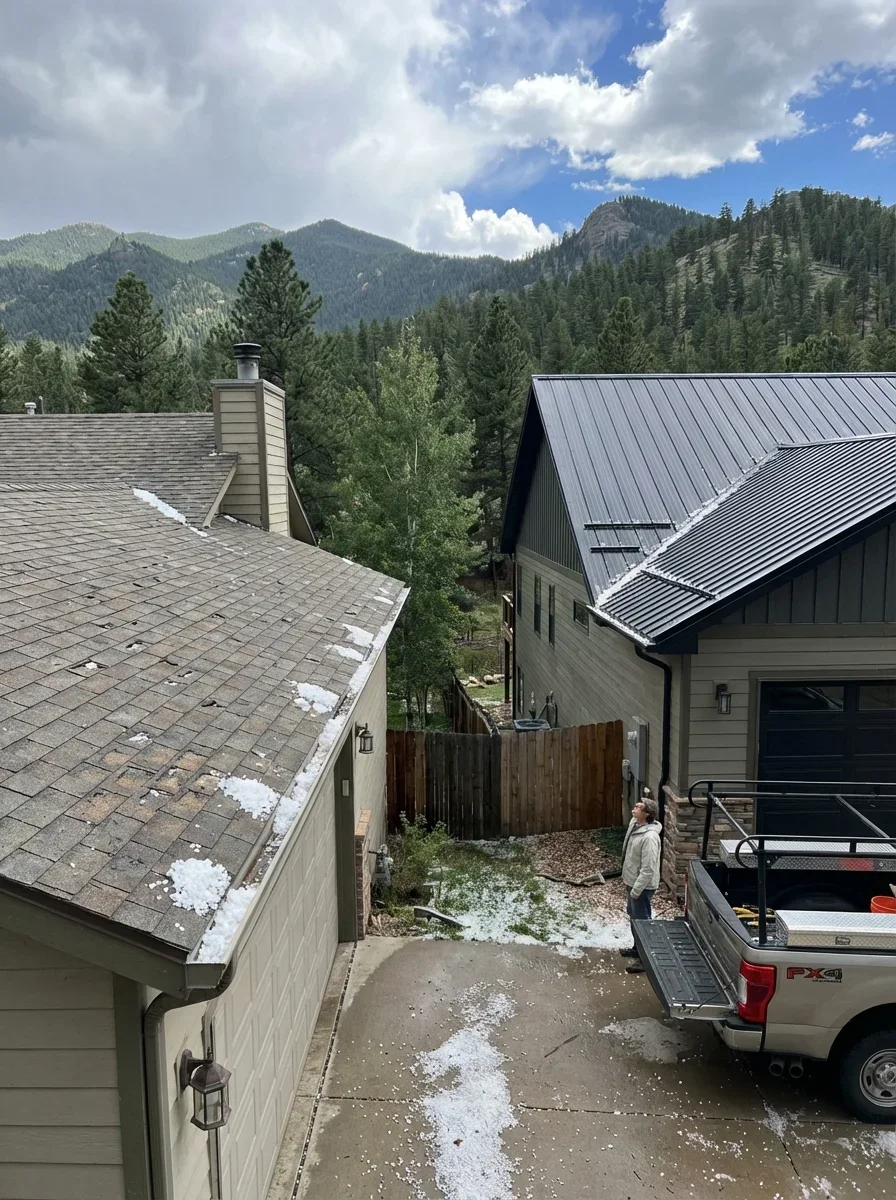
Colorado's Front Range corridor sees more hail than almost anywhere in the United States. Denver, Aurora, and Colorado Springs take seven or more significant hail events annually. That makes impact resistance the single most important factor for many homeowners.
Class 4 impact-resistant asphalt shingles are rated to withstand 2-inch hailstones without cracking, and they deliver insurance premium discounts of 15-28% in most Colorado policies.
Homeowners report mixed results depending on shingle quality and hail size. After a severe May storm in Colorado Springs, several neighborhoods with Class 4 asphalt shingles came through with minimal damage. Mostly cosmetic bruising where hailstones hit flat. The same storm dented metal roofs and broke interlocking seams on thinner 26-gauge smooth steel tiles.
That surprised homeowners who expected metal to outperform shingles across the board.
Thicker standing-seam metal (24-gauge or heavier) held up better, but dents on ridge caps and valleys were still visible.
Here's the reality: both materials can fail under severe hail, but failure modes differ. Asphalt shingles crack or lose granules, which leads to leaks within months if not repaired. Metal dents but rarely punctures unless the gauge is too thin or the hail exceeds 2.5 inches. Dents are mostly cosmetic. The roof still sheds water. But they're permanent and visible, which matters if resale value is a concern.
Pro Tip: In Colorado's hail alley, don't choose metal roofing thinner than 24-gauge for standing-seam or 26-gauge for other styles. Thinner panels save money upfront but dent easily, creating permanent cosmetic damage that insurance may not cover as functional failure.
Why Class 4 Ratings Matter for Insurance
Colorado insurance carriers increasingly require or strongly incentivize Class 4 impact-resistant shingles. All asphalt shingles installed in Denver must comply with ASTM D 7158 or ASTM D 3161 for wind speeds of 90, 100, or 110 mph, depending on your home's exposure.[1] That's not optional. It's code. If your roof doesn't meet that standard, your insurance claim could be reduced or denied outright.
Metal roofing automatically qualifies for similar or better insurance discounts because steel and aluminum are inherently impact-resistant. But not all metal is equal. Smooth steel tiles (especially those under 26-gauge thickness) are vulnerable to hail damage where interlocking seams break. Standing-seam panels with concealed fasteners perform better because there are no exposed tabs to catch hailstones.
If you're in a high-hail zone like Centennial, Thornton, or Erie, verify that any roofing material carries a Class 4 UL 2218 rating. That rating is what triggers insurance discounts and gives you leverage during insurance claim negotiations.
Snow and Ice Performance: Shedding vs Retention
Colorado winters deliver heavy snow loads, especially along the Front Range where lake-effect storms dump 12 to 24 inches overnight. Metal roofing sheds snow almost immediately once surface temperatures rise above freezing. The smooth, low-friction surface allows snow to slide off in sheets, reducing structural load on your trusses and eliminating ice dam risk in most cases.
That's a huge advantage if you live in Boulder, Evergreen, or Estes Park where snow sits on roofs for weeks.
Asphalt shingles hold snow longer because granules create friction. That's not always a bad thing. Retained snow acts as insulation, keeping attics cooler and reducing heating costs during cold snaps. But retained snow also increases the risk of ice dams when warm attic air melts the bottom layer of snow, sending water downslope until it refreezes at the eaves. Once an ice dam forms, water backs up under shingles and leaks into your home. Ice dam prevention becomes a recurring maintenance task on asphalt roofs, especially if attic insulation or ventilation is inadequate.
Metal's snow-shedding ability eliminates ice dam risk but introduces a new concern: where does the snow go?
A sudden sheet of compacted snow sliding off your roof can damage gutters, landscaping, or vehicles parked below. Many homeowners install snow guards (metal bars or cleats that break up snow into smaller chunks) which adds $2 to $5 per linear foot to your installation cost.
Freeze-Thaw Cycles and Flashing Integrity
Colorado's 60°F daily temperature swings in winter cause rapid freeze-thaw cycling. Water seeps into small gaps around flashing or under shingle edges during the day, then freezes overnight and expands. That expansion cracks sealant, lifts shingles, and loosens flashing. Especially around chimneys, skylights, and valleys.
Asphalt shingles are more vulnerable because the organic mat expands and contracts at a different rate than metal flashing, creating gaps over time.
Metal roofing expands and contracts as a single system. Flashing and panels are often the same material, and movement is predictable. Contractors account for thermal expansion during installation by using floating clips or allowing panels to slide slightly at attachment points. That design reduces the stress that breaks seals on asphalt roofs.
If you're dealing with expansive clay soil along the Front Range (common from Castle Rock to Longmont), foundation movement adds another layer of stress to your roofline. Shifting foundations can break flashing seals and open gaps at roof penetrations. Metal roofing tolerates that movement better because panels aren't rigidly fastened, but you'll still need to inspect and reseal flashing every few years.
Energy Efficiency and Cooling Costs in Colorado Summers
Metal roofing reflects solar radiation more effectively than asphalt shingles, which absorb heat and transfer it into your attic. That reflectivity (measured as solar reflectance) ranges from 25% to 70% depending on the finish. Lighter-colored metal roofs with reflective coatings can cut cooling costs by 10-25% during Denver's 90°F summer days, which is why the U.S. Department of Energy highlights reflective metal as a "cool roof" option.[2]
Asphalt shingles absorb heat, which can actually benefit Colorado homeowners during shoulder seasons. That absorbed heat helps melt snow faster in spring and late fall, reducing the need for roof snow removal services.
But during July and August, dark asphalt shingles can push attic temperatures above 150°F, forcing your air conditioner to work harder. Some homeowners consider reflective coatings to make asphalt shingles "cool," but the Department of Energy warns that field-applied coatings on asphalt can trap moisture and void manufacturer warranties.[2]
Colorado's climate sits in a sweet spot where both heating and cooling matter. Metal roofing's reflectivity saves money in summer, but you'll pay slightly more to heat your home in winter because the roof doesn't retain heat. Asphalt shingles do the opposite. Higher cooling costs in summer, lower heating costs in winter. The net difference is small for most homes, maybe $100 to $200 annually, but it adds up over a 30-year lifespan.
Energy Performance Quick Facts:
- Metal roofs reflect 25-70% of solar radiation vs. asphalt's 10-20%
- Potential cooling cost savings: 10-25% during Colorado summers
- Light-colored metal loses 10-15% reflectivity over 15 years due to UV exposure
- Annual net energy cost difference: $100-$200 (varies by insulation quality)
- Reflective coatings on asphalt may void warranties—check with manufacturer first
Does Cool Roofing Pay Off at High Altitude?
Denver averages 300 sunny days per year, which means solar gain is a factor even during mild weather. Reflective metal roofing performs best in homes with poorly insulated attics or in multi-story homes where upper-floor bedrooms overheat during summer afternoons.
If your attic already has R-38 or better insulation, the benefit of a reflective roof shrinks. You're paying for performance you don't need.
One caution: Colorado's intense UV exposure fades reflective coatings faster than in lower-altitude climates. Expect your white or light-colored metal roof to lose 10-15% of its reflectivity within 15 years due to UV degradation. Dark asphalt shingles don't fade as noticeably because they start out absorbing 90%+ of solar radiation. There's nowhere to go but slightly less black.
Maintenance Requirements and Long-Term Repairs
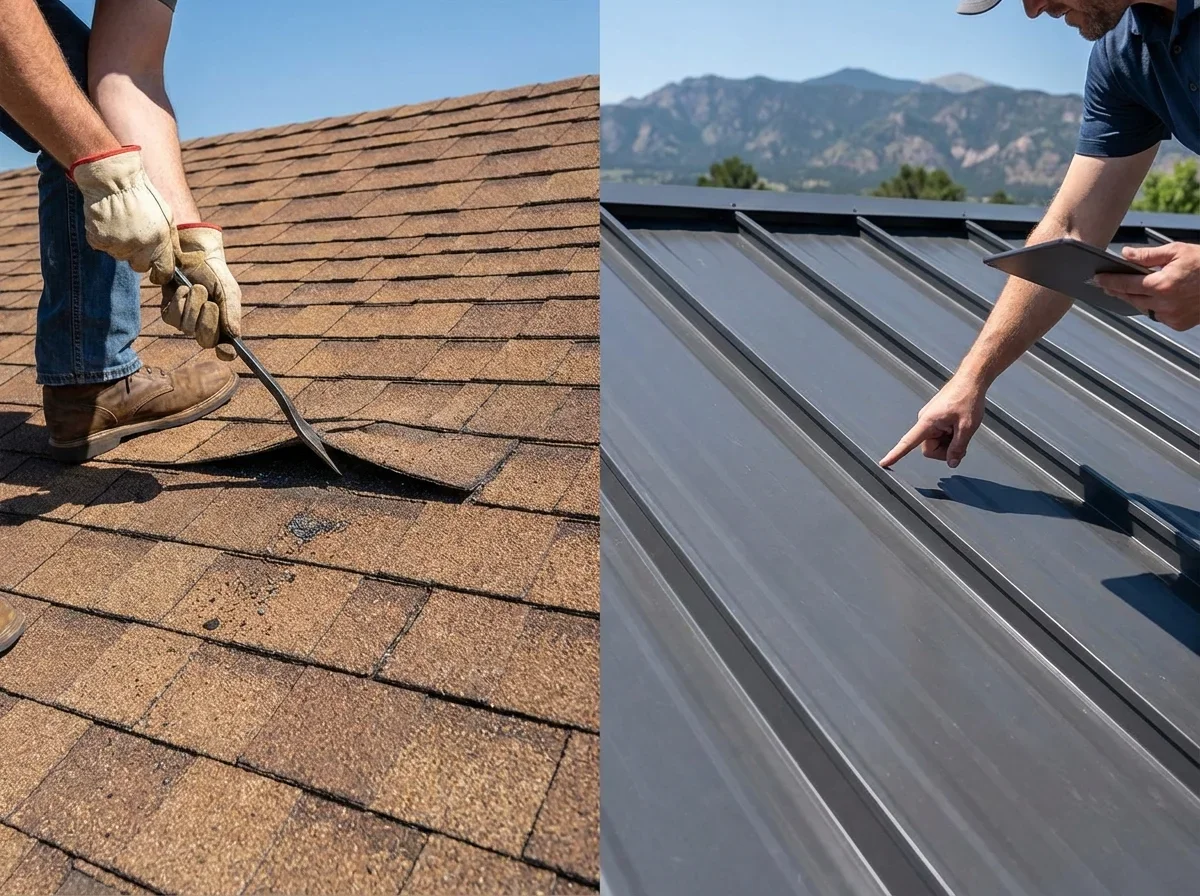
Asphalt shingles require regular inspections after every significant hail event, which in Colorado means twice a year at minimum. You're checking for cracked tabs, missing granules, lifted edges, and damaged flashing. Minor repairs (replacing a few shingles or resealing flashing) cost $200 to $600 depending on roof access and the extent of damage.
But hail damage often spreads across the entire roof, triggering a full replacement claim.
Metal roofing needs far less maintenance. Mostly inspections to ensure fasteners haven't backed out and sealant around penetrations hasn't cracked. You'll want to check fasteners every five years and reseal flashing every 10 to 15 years, but those are minor tasks compared to the recurring shingle replacements that Colorado's climate demands. Homeowners who installed metal in the 1990s report spending less than $500 total on maintenance over 30 years.
One trade-off: metal roofing repairs require specialty contractors. If a panel gets damaged or a seam separates, you can't just patch it with a tube of roofing cement the way you can with asphalt. You need someone who understands how standing-seam systems interlock and can fabricate matching panels. That limits your repair options and increases costs when something does go wrong.
Storm Chaser Contractors and Post-Hail Scams
Colorado's hail season brings a flood of out-of-state contractors (often called "storm chasers") who canvas neighborhoods after major events. These crews knock on doors offering free inspections, push homeowners to file insurance claims, and sometimes perform substandard work before disappearing.
The lack of a state-level roofing license in Colorado makes it easier for unqualified contractors to operate, so verifying credentials becomes your responsibility.
Before hiring anyone after a storm, check local licensing at the municipal level. Denver, Colorado Springs, Aurora, and Fort Collins all require contractor registration. Ask for proof of liability insurance and workers' compensation coverage (both are required by most municipalities even though they're not mandated statewide). You can verify general contractor licenses through the Colorado Division of Regulatory Agencies at https://www.colorado.gov/dora, though roofing-specific licenses don't exist at the state level.
If you're choosing between a local contractor with 20 years in the Denver market and a storm chaser from Texas offering a price that's 30% lower, the local contractor is almost always the safer bet. They'll be around to honor warranties and fix problems that show up months after installation. For more on vetting contractors, see how to verify a Colorado roofing contractor.
Wind Resistance and Colorado's Chinook Events
Colorado's wind doesn't just blow. It howls.
Chinook winds along the Front Range can hit 80 to 100 mph during winter, stripping shingles and peeling back flashing in minutes. All asphalt shingles installed in Denver must meet ASTM D 7158 or ASTM D 3161 for wind speeds of 90, 100, or 110 mph depending on your home's exposure and roof pitch.[1] That's a baseline requirement, not a premium feature.
Metal roofing with concealed fasteners performs exceptionally well in high winds because there are no exposed tabs to catch wind and lift. Standing-seam systems lock together mechanically, creating a continuous surface that sheds wind rather than fighting it. Homeowners in high-wind zones like Boulder and Lyons report zero wind damage on metal roofs even during 90 mph gusts, while neighbors with asphalt shingles lose dozens of tabs during the same events.
Exposed-fastener metal panels (common in agricultural buildings but sometimes used on homes) are more vulnerable because wind can catch the overlapping edges and peel them back. If you're considering metal, stick with standing-seam or concealed-fastener systems. The upfront cost is higher, but the wind resistance is night-and-day better than screwed-down panels.
How Roof Pitch Affects Wind Performance
Steeper roofs (7:12 pitch or greater) shed wind more effectively than low-slope roofs, which means wind uplift becomes a bigger concern on homes with shallow pitches common in ranch-style construction. If your home has a 4:12 or 5:12 pitch, metal roofing's mechanical interlocking gives you an edge over asphalt shingles, which rely on adhesive strips to stay in place.
Those strips weaken over time, especially under UV exposure, and once they fail, a strong gust can strip an entire section in seconds.
Colorado's building codes account for this by requiring higher wind ratings in certain zones, but enforcement varies by municipality. If you're replacing your roof, ask contractors to specify the wind rating for your chosen material and verify that it meets or exceeds local code. Storm damage repair specialists see preventable wind damage constantly, usually because the previous installer cut corners on fasteners or didn't seal edges properly.
Noise Levels During Rainstorms and Hail
Metal roofing amplifies sound. Rain sounds like drumming. Hail sounds like someone throwing gravel at your house.
Some homeowners find it soothing (a gentle patter during summer thunderstorms). Others find it unbearable, especially during intense hail events when the noise drowns out conversation and wakes sleeping kids.
Asphalt shingles dampen sound naturally because the mat and granules absorb impact. You'll hear hail if you're paying attention, but it's muffled compared to metal. That acoustic difference matters more than you'd expect. Multiple Colorado homeowners mention wishing they'd factored in noise before installing metal, particularly in bedrooms directly under the roofline.
You can reduce metal roofing noise significantly with proper insulation. Adding R-30 or better insulation in your attic creates a buffer that absorbs sound before it reaches living spaces. Solid sheathing (plywood or OSB) under the metal panels also helps compared to skip sheathing, which some installers use to cut costs. If noise is a concern, budget an extra $1 to $3 per square foot for sound-dampening insulation during installation.
That upfront investment pays off every time it hails.
Fire Resistance and Wildfire Risk in Mountain Communities
Metal roofing carries a Class A fire rating (the highest available) because it won't ignite or contribute to fire spread. That's critical in Colorado's wildland-urban interface (WUI) zones along the foothills, where the 2021 Marshall Fire destroyed over 1,000 homes in Boulder County. Many mountain communities from Conifer to Divide now mandate Class A fire-rated roofing, which effectively bans traditional cedar shake and limits your choices to metal, tile, or fire-rated composite materials.
Asphalt shingles also earn Class A ratings when installed over fire-resistant underlayment, so they're allowed in most WUI zones. But metal's non-combustible surface provides an extra layer of protection when embers land on your roof during a wildfire.
Asphalt can smolder if embers find a gap in the shingles or if prolonged heat exposure ignites the organic mat.
If you're building or replacing a roof in Evergreen, Idaho Springs, or any foothill community, check local fire codes before choosing materials. Some jurisdictions require specific underlayment types or mandate metal flashings even under asphalt shingles. For fire-rated alternatives to traditional cedar, see cedar shake vs synthetic fire-rated options.
Insurance Discounts and Premium Impacts
Colorado homeowners with Class 4 impact-resistant roofing (either asphalt shingles or metal) receive premium discounts ranging from 15% to 28% depending on the carrier. That discount compounds annually, which means you're saving $200 to $600 per year on a typical $2,000 annual premium.
Over 20 years, that's $4,000 to $12,000 in savings, which offsets a significant portion of metal roofing's higher upfront cost.
Insurance carriers also factor in claims history. If your roof has filed two hail claims in five years, expect your premiums to spike or your policy to non-renew. Metal roofing's durability reduces claim frequency, which keeps your insurance record clean and your premiums stable. Homeowners who switched from asphalt to metal after multiple hail claims report lower premiums within two policy cycles. Not just from the material discount, but from the absence of new claims.
Deductibles have climbed sharply in Colorado's hail-prone areas. Many policies now carry 1-2% deductibles for wind and hail damage, which means you're paying $5,500 to $11,000 out of pocket on a $550,000 home before insurance covers anything. That makes durability a financial decision, not just a preference. A roof that avoids claims is more valuable than one that needs replacement every 15 years, even if the replacement is covered by insurance.
Documentation and Claim Assistance
If you do file a claim, metal roofing is easier to assess because damage is visible (dents, bent seams, or separated panels). Asphalt shingle damage can be subtle, especially when it's granule loss or micro-cracking that won't leak for months.
Insurance adjusters sometimes deny asphalt claims by arguing that damage is from wear rather than storm impact, which forces homeowners to hire third-party inspectors or public adjusters.
Many Colorado roofing contractors offer insurance claim assistance and documentation as part of their service. They photograph damage, meet with adjusters, and provide written assessments that support your claim. If you're dealing with a disputed claim, hiring a contractor with insurance restoration experience can mean the difference between a full payout and a partial denial.
Resale Value and Buyer Preferences
Metal roofing increases home resale value in Colorado's market, especially in mountain communities and high-end Denver suburbs where buyers expect low-maintenance features. A home with a recently installed metal roof in Boulder or Castle Pines can command a 1-3% premium over comparable homes with asphalt shingles, which translates to $5,500 to $16,500 on a $550,000 home.
But buyer preferences vary by neighborhood.
In middle-market areas like Aurora or Thornton, many buyers don't assign extra value to metal roofing. They see it as a neutral feature, not a selling point. Some buyers actively dislike the appearance of metal, especially standing-seam panels, which they find too industrial or modern for traditional ranch-style homes. Asphalt shingles remain the default expectation, and anything else requires explanation or justification.
If you're planning to sell within five years, installing metal roofing might not recoup its full cost. You'll recover maybe 60-80% of the installation expense in resale value, which leaves you paying for performance you won't use. But if you're staying 10-plus years, metal's longevity and low maintenance become selling points that appeal to buyers who've experienced Colorado's hail season firsthand.
Local Licensing and Contractor Selection
Colorado's lack of a state roofing license means your due diligence is more important than in states with strict licensing boards. You're verifying contractor credentials at the municipal level, checking insurance coverage, and confirming references. All tasks that take time but protect you from poor workmanship and financial loss.
Start by confirming that any contractor you hire is registered with your local municipality. Denver requires registration through the Community Planning and Development office. Colorado Springs requires a business license through the City Clerk's office. Aurora, Boulder, Fort Collins, and Lakewood each have their own systems.
If a contractor isn't registered locally, walk away. They're either unlicensed or working under someone else's registration, which creates liability issues if something goes wrong.
Ask for proof of general liability insurance and workers' compensation coverage. Both are required by most municipalities even though they're not state-mandated. If a worker gets injured on your property and the contractor doesn't carry workers' comp, you could be liable for medical costs and lost wages. Don't accept verbal assurances. Ask for certificate of insurance naming you as an additional insured, and call the insurance company to verify coverage is active.
For more detail on contractor verification, see how to hire a roofing contractor in Colorado.
When to Choose Asphalt Shingles Over Metal
Asphalt shingles make sense if you're working with a tight budget and need a roof that performs adequately in Colorado's climate without breaking $20,000. Class 4 impact-resistant architectural shingles cost half what metal does, install quickly, and qualify for the same insurance discounts.
If you're planning to sell in five years or less, paying for a 50-year roof doesn't make financial sense. You won't recoup the premium in resale value.
Asphalt also makes sense if you value flexibility. You can find contractors year-round who work with asphalt, and repairs are straightforward. If a section gets damaged, you're not hunting for specialty installers or waiting weeks for custom panels. You replace the damaged shingles and move on. That accessibility matters if you're in a remote mountain community where contractor availability is limited.
The aesthetic factor matters too. Asphalt shingles blend seamlessly with traditional ranch-style and suburban homes common across the Front Range. They're invisible in a good way. Buyers don't notice them, and neighbors don't comment. Metal roofing makes a statement, which some homeowners love and others prefer to avoid.
When to Choose Metal Roofing Over Asphalt
Metal roofing is the better long-term investment if you're staying in your home 15-plus years and value low maintenance. You'll avoid the recurring replacement cycle that asphalt demands in Colorado's climate, and you'll spend less over the life of the home even accounting for the higher upfront cost.
Homeowners in their 40s and 50s who don't plan to move again often choose metal precisely because they don't want to re-roof in retirement.
Metal also makes sense in high-risk zones: mountain homes above 8,000 feet where snow loads and wildfire risk are constant concerns, or Front Range neighborhoods like Centennial and Highlands Ranch where hail strikes multiple times per year. If your insurance deductible is 1-2% and you've already filed one claim in the past five years, metal roofing becomes a defensive play to avoid future claims and premium spikes.
Energy-conscious homeowners benefit from metal's reflectivity, especially in multi-story homes or homes with south-facing exposures. The 10-25% reduction in cooling costs compounds over decades, and when you factor in lower maintenance costs, metal's total cost of ownership drops below asphalt by year 25 in most scenarios.
Finally, metal makes sense if you care about sustainability. A metal roof can be recycled at end-of-life, while asphalt shingles contribute millions of tons to landfills annually.
If environmental impact factors into your decision, metal roofing wins handily.
Total Cost of Ownership: 30-Year Comparison
Run the numbers over 30 years and the cost gap between asphalt and metal shrinks. Assume you install asphalt shingles for $12,000 in 2026. After 18 years (realistic for Colorado's climate) you replace them for $15,000 (accounting for 2% annual inflation). Total cost: $27,000 over 30 years, plus routine inspections and minor repairs after hailstorms, which add another $1,500 to $3,000.
Now assume you install metal roofing for $28,000 in 2026. After 30 years, you've spent $28,000. No replacement, minimal maintenance beyond fastener checks and flashing reseals. Add $500 to $1,000 for those minor tasks, and your total is $29,000.
The lifetime cost difference is negligible, but the experience is wildly different.
Asphalt requires you to navigate two full roof replacements, file insurance claims, deal with contractors during peak season, and live through weeks of construction noise. Metal requires almost nothing. You inspect it occasionally, fix a fastener if one backs out, and forget about it for decades.
That convenience has value beyond dollars. Homeowners who chose metal ten years ago consistently describe it as "one less thing to worry about." Which matters in a state where hail season creates constant low-grade anxiety.
Frequently Asked Questions
Get Colorado-specific pricing based on material, region, and roof size.
- City and County of Denver. "Residential Roofing Guidelines." https://www.denvergov.org/content/dam/denvergov/Portals/696/documents/Single-family_duplex/Residential_Roofing_Guidelines.pdf. Accessed April 08, 2026.
- U.S. Department of Energy. "Cool Roofs." https://www.energy.gov/energysaver/cool-roofs. Accessed April 08, 2026.